Introduction
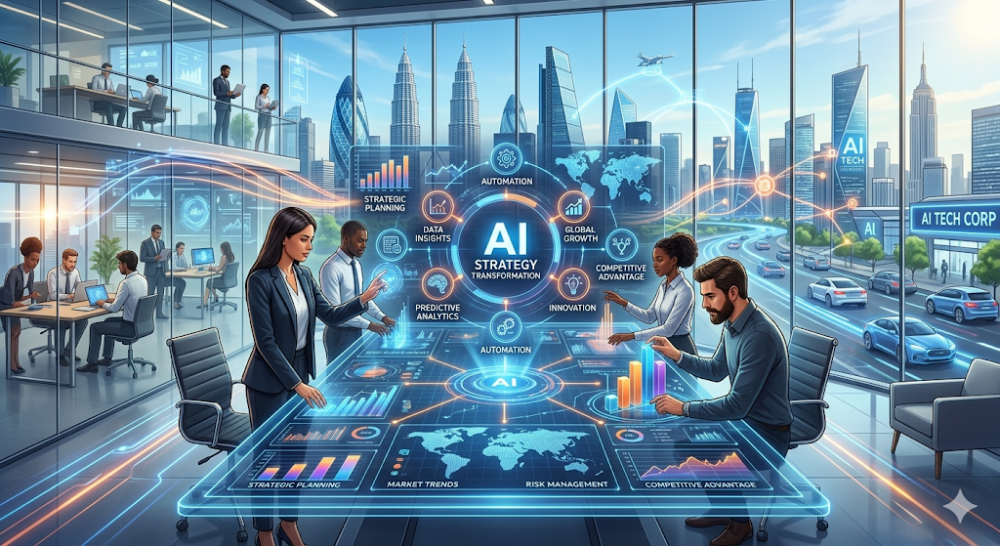
Artificial Intelligence has become one of the most powerful technologies shaping the modern business world. Companies across different industries are now using AI to improve their operations, understand customer behavior, increase productivity, and make smarter decisions. From small startups to large international corporations, AI is helping businesses create better strategies that lead to long-term success. The growing importance of AI in business strategy is changing how companies compete in the digital market and how they prepare for future challenges.
In the past, business decisions were mainly based on human experience, market research, and historical data. Today, AI systems can process huge amounts of information within seconds and provide insights that help companies make accurate and faster decisions. This transformation is allowing organizations to reduce costs, improve efficiency, and discover new growth opportunities. As technology continues to evolve, AI is becoming an essential part of business strategy rather than just an optional tool.
Understanding AI in Business Strategy
AI in business strategy refers to the use of artificial intelligence technologies to support planning, decision-making, and business operations. It includes machine learning, predictive analytics, natural language processing, automation tools, and intelligent software systems. These technologies help businesses analyze data, predict trends, automate repetitive tasks, and improve overall performance.
Modern companies use AI to understand market conditions, customer preferences, and industry trends more effectively. AI-powered systems can collect information from websites, social media platforms, customer interactions, and sales reports to generate valuable insights. This information allows business leaders to develop strategies that are more data-driven and customer-focused.
The integration of AI into business strategy is also changing the role of management teams. Leaders now rely on intelligent systems to support strategic planning and identify potential risks before they become serious problems. AI does not replace human decision-making completely, but it improves the quality and speed of decisions by providing accurate information and predictions.
AI Improves Decision-Making
One of the biggest advantages of AI in business strategy is improved decision-making. Businesses generate large amounts of data every day, and analyzing this information manually can be difficult and time-consuming. AI systems can quickly process complex data and identify patterns that humans may not notice.
Companies use AI tools to predict customer behavior, market trends, and future demand. This helps businesses create better marketing campaigns, manage inventory efficiently, and plan future investments. For example, retail companies use AI to analyze customer purchasing habits and recommend products based on personal preferences. Financial institutions use AI to detect fraud, evaluate risks, and improve investment strategies.
AI also helps companies reduce human errors in decision-making. Since AI systems rely on data analysis rather than emotions or assumptions, they can provide more accurate recommendations. This allows businesses to respond quickly to changing market conditions and make strategic decisions with greater confidence.
Enhancing Customer Experience
Customer experience has become one of the most important factors for business success. Companies that provide better customer service often gain higher customer loyalty and stronger brand reputation. AI is playing a major role in improving customer experience by helping businesses understand and respond to customer needs more effectively.
Many companies use AI-powered chatbots and virtual assistants to provide instant customer support. These systems can answer customer questions, solve common problems, and assist users at any time of the day. This improves customer satisfaction while reducing the workload on support teams.
AI also helps businesses personalize their services. Online platforms like e-commerce websites and streaming services use AI algorithms to recommend products, movies, or content based on user behavior. Personalized recommendations increase customer engagement and encourage more sales. Businesses can also use AI to analyze customer feedback and identify areas where improvements are needed.
The ability to offer personalized experiences is becoming a key part of modern business strategy. Companies that successfully use AI to understand customer preferences are more likely to maintain a competitive advantage in the market.
Automation and Increased Efficiency
Automation is another important way AI is transforming modern companies. Many business tasks are repetitive and require significant time and resources. AI-powered automation allows companies to complete these tasks faster and more accurately.
Businesses use AI automation in areas such as data entry, inventory management, customer service, and financial reporting. This reduces operational costs and allows employees to focus on more important and creative tasks. Manufacturing companies use AI-powered robots to improve production speed and maintain product quality. Logistics companies use AI systems to optimize delivery routes and reduce transportation costs.
Automation also increases workplace productivity. Employees can spend less time on routine work and more time on innovation, problem-solving, and strategic planning. As a result, businesses become more efficient and competitive.
In addition, AI helps companies identify inefficiencies in their operations. Intelligent systems can monitor performance, analyze workflows, and suggest improvements that save time and resources. This makes AI an essential tool for businesses aiming to improve operational efficiency.
AI and Competitive Advantage
In today’s competitive business environment, companies must continuously innovate to stay ahead. AI provides businesses with a strong competitive advantage by helping them respond quickly to market changes and customer demands.
Businesses that use AI effectively can analyze competitors, identify industry trends, and predict future opportunities more accurately. AI tools can track online consumer behavior, monitor market conditions, and provide real-time insights that support strategic planning.
Companies that adopt AI early often gain an advantage over competitors that rely on traditional business methods. They can launch products faster, improve customer experiences, and optimize operations more effectively. AI also supports innovation by helping businesses develop new products and services based on customer preferences and market demands.
The use of AI in business strategy is becoming a major factor in determining which companies succeed in the digital economy. Organizations that fail to adopt AI may struggle to compete with businesses that use advanced technologies to improve performance and customer satisfaction.
Challenges of Using AI in Business Strategy
Although AI offers many benefits, businesses also face several challenges when implementing AI technologies. One of the biggest challenges is the high cost of AI development and integration. Small businesses may find it difficult to invest in advanced AI systems due to limited budgets and technical resources.
Another challenge is data privacy and security. AI systems rely heavily on data collection and analysis, which raises concerns about customer privacy and information protection. Companies must ensure that they follow data protection laws and maintain strong cybersecurity measures.
There is also a growing concern about job displacement caused by automation. As AI systems automate repetitive tasks, some employees may worry about losing their jobs. Businesses must focus on employee training and skill development to help workers adapt to changing workplace requirements.
In addition, AI systems are not always perfect. Incorrect data or poor algorithms can lead to inaccurate predictions and decisions. Companies need skilled professionals to manage AI systems and ensure that the technology is used responsibly and effectively.
The Future of AI in Business Strategy
The future of AI in business strategy looks extremely promising. As AI technologies continue to improve, businesses will gain access to more advanced tools that support innovation, automation, and strategic growth. AI is expected to become even more integrated into business operations in the coming years.
Future AI systems may provide deeper insights into customer behavior, automate more complex tasks, and improve collaboration between humans and machines. Businesses will likely use AI for advanced forecasting, risk management, and strategic planning on a larger scale.
Industries such as healthcare, finance, retail, education, and manufacturing are expected to experience major transformations through AI adoption. Companies that invest in AI today are preparing themselves for a future where intelligent technologies will play a central role in business success.
At the same time, businesses must focus on ethical AI practices and responsible technology use. Transparency, fairness, and data protection will become important parts of AI-driven business strategies.
Conclusion
AI in business strategy is transforming modern companies in powerful ways. It is improving decision-making, enhancing customer experiences, increasing efficiency, and helping businesses gain a competitive advantage. Companies across different industries are using AI technologies to improve operations, reduce costs, and create smarter strategies for long-term growth.
Despite the challenges associated with AI adoption, the benefits are too significant to ignore. Businesses that successfully integrate AI into their strategies are more likely to succeed in the rapidly evolving digital economy. As technology continues to advance, AI will become an even more important part of business strategy and organizational success.
Modern companies that embrace AI today are building a stronger foundation for future innovation, growth, and competitiveness. The role of AI in business strategy will continue to expand, shaping the future of businesses around the world.