Your AI pilots are producing results. Your production systems are not keeping pace. That gap is where most enterprise AI investment stalls, and it has very little to do with the quality of the models your team selected.
The friction lies in the connective tissue: APIs that were never designed for AI traffic, legacy databases buried behind layers of middleware, and CRM systems that hold years of customer history but cannot serve that data to a model in real time. When you introduce AI into that environment, you are not deploying intelligence. You are deploying a system that runs into walls at every turn.
That is the problem AI integration services exist to solve. The question for your organization is not whether AI belongs in your enterprise. It is whether your enterprise is structured to support it.
The Distance Between a Good Model and a Working System
Most technology leaders have a clear picture of what AI should do for their business. The harder question is how to get there. A language model sitting atop disconnected data sources does not transform operations. It generates output that your team then has to verify, correct, and manually push through a process, which defeats the purpose entirely.
Effective AI integration services for enterprises close that distance. They are not about the model itself. They are about the architecture surrounding it: how data flows in, how decisions flow out, and how the whole system behaves under real operating conditions with real data volumes.
When those connections work correctly, AI stops being a tool your team consults occasionally. It becomes the infrastructure your business runs on. That shift is what separates organizations capturing measurable returns from those still iterating on proofs of concept.
What the Integration Layer Covers
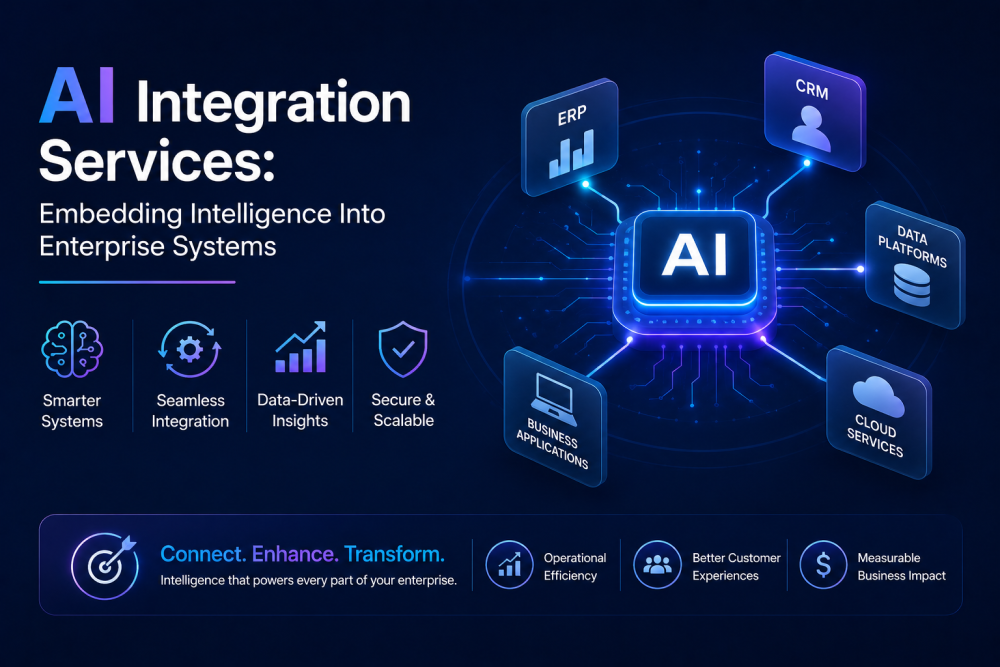
AI integration solutions span considerably more ground than most organizations expect going in. The work breaks into four areas, and each one has to function before the next delivers value.
Data Pipeline Architecture
Building governed, real-time flows from source systems into AI applications. This covers both structured and unstructured data, and it requires decisions about latency, format, and access controls before a single model call is made.
Legacy System Connectivity
Most enterprise infrastructure was not built with AI in mind. Embedding intelligence means constructing abstraction layers, including APIs, middleware, and data virtualization, so that older systems can participate in modern workflows without a full replacement.
Model Deployment and Monitoring
Moving trained models from development into production, with the versioning, feedback loops, and observability needed to detect drift before it corrupts your outputs.
Workflow Automation
Connecting AI outputs to the downstream actions that create business value. A recommendation that never triggers a process is just a suggestion. The integration layer is what converts it into a result.
Artificial intelligence integration services that address all four areas produce systems that hold up under real conditions. Approaches that skip steps, most often legacy connectivity or monitoring, tend to produce systems that perform well in demos and degrade quietly in production.
Data Silos Are Where AI Investments Go Silent
Fragmented data is the most common reason AI initiatives fail to deliver at scale. When your AI system cannot reach the data it needs, it compensates by drawing patterns from whatever subset of reality it can access. It then presents those patterns with confidence. That is a problem.
Your procurement system uses a different schema than your ERP. Your service desk data lives in a warehouse that nobody ingests in real time. Your forecasting model sees CRM activity but not contract history. Each gap erodes accuracy, and accuracy compounds. A model that is slightly wrong today shapes the next iteration to be wrong in a more sophisticated way.
Organizations that treat integration as a second phase, something to address after the model is built, are constructing on an unstable foundation. The data layer is the prerequisite. Fixing it after the fact is far more expensive than building it correctly the first time.
Building an Architecture That Holds at Scale
Connections that work fine at pilot scale often buckle when real enterprise volume runs through them, or when a new source system needs to be added mid-year. The architectural decisions you make now determine how much you pay to scale later.
A few principles tend to distinguish integration architectures that age well from those that require rework:
- Event-driven over batch: Real-time AI applications need data that reflects the current state of your business, not last night’s snapshot. Event-driven architecture gives your models live signals to act on.
- API-first connectivity: Systems that expose clean, versioned APIs are far easier to connect with AI layers and future tooling. Governance investment in APIs today reduces the cost of every integration you build afterward.
- Centralized governance, distributed access: Data locked in one location is not useful. Data without governance is not trustworthy. The right model gives teams the access they need while maintaining consistent quality and security standards.
- Observability from day one: Integration failures are often gradual. A pipeline degrades rather than breaks. Building in monitoring and alerting from the start means issues surface before they reach your model outputs.
- Gartner projects that 40% of enterprise applications will be integrated with task-specific AI agents by the end of 2026, up from less than 5% today. Organizations that have built for scale will absorb that expansion without disruption. Those that have not will face a rearchitecting effort on top of a system already in production.
Where the Returns Become Visible
The business impact of well-executed AI integration shows up in specific, measurable places once the foundational work is done.
In service operations, integrated AI reduces the time your team spends routing, categorizing, and escalating tickets. Cases that required three handoffs now resolve in one. Your agents handle the same volume with fewer manual steps and shorter cycle times.
In supply chain and procurement, real-time data pipelines let AI flag anomalies before they become disruptions. A supplier delay that previously appeared in a weekly report now surfaces as an alert on the day the data changes.
In sales, connected AI means your forecasting model draws on CRM activity, web behavior, and contract history in a single view. Your team stops pulling data from four systems and starts acting on one reliable signal. Deals close faster because the right information is already in the right place.
McKinsey’s 2025 State of AI research confirms that organizations integrating AI into core business workflows achieve three to five times greater ROI on their AI investments than those that do not. The differentiating variable is not the model. It is the integration.
Final Thoughts
AI integration is the part of enterprise AI that rarely features in strategy presentations but consistently determines whether AI programs succeed or stall. The models are mature. The data pipelines, legacy bridges, and governance frameworks are where execution lives.
If your AI initiatives are stuck at the pilot stage, the answer is almost never a better model. It has better connectivity. Getting that right once pays dividends across every use case you build afterward. Damco Solutions works with enterprise technology teams to design and deliver AI integration services that connect intelligence to operations. If you are ready to move from experimentation to scale, the integration layer is where that journey begins.