Introduction to Spiral Roller Brushes
What are Spiral Roller Brushes?
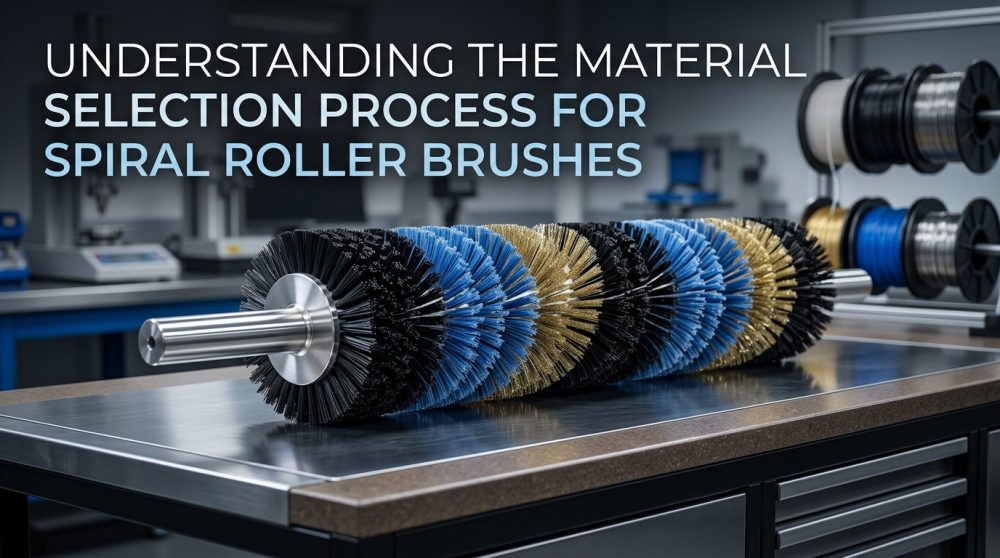
Spiral roller brushes are cylindrical brushes where the filament or wire is wound in a helical pattern around a core. This spiral arrangement affects how the brush contacts a surface, how debris is cleared, and how evenly bristles wear over time. The core is typically steel or aluminium, and the fill material ranges from steel wire to nylon to abrasive-impregnated filaments.
Common Industrial Applications
Industrial Spiral roller brushes are used across deburring stations, rolling mills, food processing lines, conveyor cleaning systems, and surface preparation equipment. The automobile sector uses them for cleaning and finishing cast parts. Food processing lines rely on them for washing produce. Each application has different surface hardness, contamination type, and finish requirements. The brush material has to match all of these.
Why Material Selection Matters
Impact on Performance and Efficiency
Pick the wrong filament and the brush simply does not do what it is supposed to do. A soft nylon brush on a heavy deburring job wears out fast and leaves burrs behind. A stiff wire brush on a soft food surface causes damage. The right material affects brush pressure, surface contact area, cutting action, and finish quality. In high-speed automated lines, any mismatch in material stiffness or fill density will show up as a variation in finish or premature wear.
Longevity and Cost-Effectiveness
A brush that costs 20% more but lasts three times longer is usually the better choice, and yet procurement often buys on price. That tends to be a false economy. Abrasive nylon filaments self-sharpen as they wear and outlast plain nylon considerably in abrasive applications. Wire brushes can fatigue and shed bristles if the wire grade is wrong for the load and speed. The real cost calculation has to include replacement frequency, changeover time, and any quality issues caused by a degraded brush.
Types of Filament Materials
Nylon Filaments
Nylon is the most commonly specified filament for non-abrasive applications. It is flexible, resistant to a reasonable range of chemicals, and handles moisture without degrading. Nylon spiral roller brushes are used in food processing, bottle washing, conveyor cleaning, and surface wiping. Filament diameter determines stiffness. Finer diameters for gentle cleaning, coarser diameters for heavier scrubbing. Most grades handle temperatures up to around 120 oC.
Abrasive Nylon Filaments
Abrasive nylon is nylon filament loaded with silicon carbide or aluminium oxide grit throughout the filament, not just on the surface. As it wears, fresh abrasives are continuously exposed. An abrasive roller brush manufacturer will typically stock these in multiple grit levels. Coarser grits for heavy deburring, finer grits for surface preparation before coating. It is used in metals, automotive component finishing, and precision engineering where a repeatable surface roughness profile is required.
Metal Wire Filaments
Steel wire is used where the application demands hard, aggressive cutting action. Scale removal, weld cleaning, rust removal, and surface keying before thermal spray are typical uses. Stainless steel wire is used where carbon contamination from regular steel would cause problems. Wire fill density and diameter selection in spiral wire brushes requires care. Too fine at high RPM and bristles deflect without cutting. Too coarse and the surface gets scratched beyond acceptable limits.
Key Factors Influencing Material Selection
Specific Application Requirements
The starting point is always the job. Cleaning is different from deburring. Deburring is different from surface finishing. The substrate matters too. Brushing soft aluminium requires a different approach to brushing hardened steel. Operating speed, feed rate, and contact pressure are part of the picture as well. A brush that works at 1,500 RPM may not behave the same at 3,000 RPM.
Environmental Conditions (Chemicals, Temperature)
Many production environments involve coolants, cutting fluids, or cleaning agents. Not all filament materials tolerate these equally. Nylon handles mild acids, alkalis, and oils reasonably well, but strong oxidising acids or certain solvents can degrade it. For aggressive chemical environments, polypropylene or PVDF may be more appropriate. Very high temperature applications, such as brushing parts fresh from heat treatment, may require specialised filaments or wire grades.
Desired Surface Finish
Some applications just need a clean surface. Others need a specific texture for adhesion or functional reasons. Abrasive nylon in finer grit grades can generate repeatable surface roughness profiles. Wire brushes produce a more random scratch pattern, acceptable for some applications but not others. Achieving a specific finish reliably requires controlling brush speed, contact pressure, and feed rate alongside the material choice.
The Importance of Customization
Tailoring Brushes to Specific Needs
Off-the-shelf spiral roller brushes cover common applications, but many processes have requirements a standard brush does not meet. Diameter, face width, core bore, fill density, and trim length all need to match the specific machine and process. Custom spiral roller brushes are not unusual in this segment. Manufacturers that have worked in this space for decades, such as Industrial Brushware Industries, which has been supplying to metals, automobile, food, pharma, and heavy engineering sectors since 1973, maintain engineering capability specifically for this.
In some cases the process is new and there is no direct precedent. That requires first-article trials with different fill materials, evaluated against the finish or deburring standard. Working with a manufacturer that has both technical knowledge and production flexibility makes a practical difference here.
Conclusion
Material selection for spiral roller brushes is not a single decision. It follows from understanding the application, the environment, the substrate, and the finish requirement. Nylon, abrasive nylon, and steel wire cover most applications, but the correct specification within each material type still requires careful evaluation. The filament material and its properties have to match the job. In most cases, the fastest way to get this right is to work with a manufacturer that understands both the brush engineering and the industrial process it is going into.