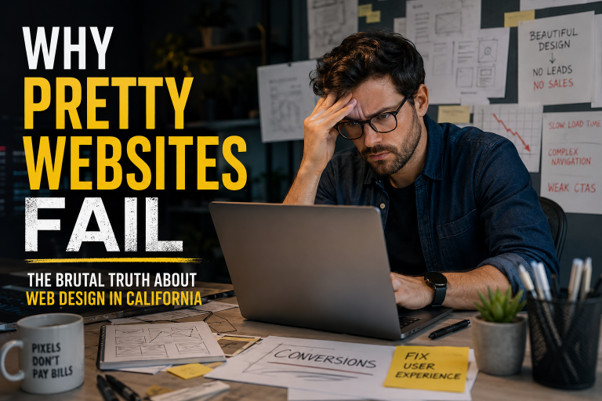
Let’s be completely honest for a second. We’ve all been totally seduced by a gorgeous website. You know exactly the kind I’m talking about. It has those silky smooth scrolling animations, cinematic drone videos playing in the background, ultra-minimalist menus, and a font style that looks like it belongs in a luxury fashion magazine. You shell out twenty or thirty grand to a trendy boutique agency in LA or San Francisco, pop a bottle of champagne with your team on launch day, and sit back waiting for the leads to pour in. Nothing happens.
The traffic is there, but your inbox is a total ghost town. The phone isn’t ringing. You even end up testing the contact form yourself just to make sure it isn’t broken. It works perfectly fine; people are just leaving your site without saying a single word.
If you are currently looking around for web design services in California, here is a piece of advice most agencies will never tell you: looking good won’t save a bad user experience. In a hyper-competitive market, a beautiful website that doesn’t get people to buy or reach out is just an incredibly expensive digital ego trip. To actually make money online, you have to fix the massive disconnect between how your site looks and how people actually use it.
The big trap: Pixels vs. human psychology
The problem is that most web designers are artists, not salespeople. They spend their days thinking about color palettes, white space, and visual harmony. That’s awesome if you’re running a digital art gallery, but it’s a total disaster if you’re a business owner trying to build a real sales pipeline.
Getting people to convert isn’t about making things pretty. It’s a behavioral science. It’s the gritty, data-driven work of figuring out why people get annoyed, where they get confused, and what exactly makes them finally click a button.
Think of it like this. Visual design is like building a stunning, architecturally flawless retail store in Beverly Hills. But if the front door is locked, the price tags are unreadable, and the checkout counter is hidden in the dark basement behind a velvet curtain, nobody is buying anything. That’s what happens when you ignore user behavior. You can’t scale a business on a slick first impression alone. You need an interface that handles the heavy lifting of selling for you.
Three ways your “award-winning” site is quietly costing you money
When business owners buy premium web design, they almost always get caught up in creative vanity. Here are three specific ways those beautiful layouts routinely flush marketing budgets down the toilet. First, “creative” navigation is a total nightmare for regular users. We see this all the time with tech startups and trendy brands. In an effort to look cutting-edge, they hide the main website menu behind a tiny icon or force you to scroll sideways instead of down. When a busy prospect lands on your page, they shouldn’t have to play a video game just to find your pricing or services. If your site forces people to think, they won’t. They’ll just hit the back button and buy from your competitor whose site is easier to read. Keep your menus boring, predictable, and exactly where people expect them to be.
Second, bloated graphics are burning your mobile traffic. That 4K video of your office looks amazing on a giant screen in a design studio. But what happens when a prospective client tries to open your site on an older iPhone with bad cell service while sitting in a local coffee shop? If your page takes longer than three seconds to load because it’s bogged down by heavy animations, they are gone. Speed is a massive part of making sales. A fast, plain website will beat a slow, gorgeous website every single day of the week.
Third, everyone seems terrified of looking “salesy” these days. Designers love to make call-to-action buttons blend beautifully into the background. They use weak, artsy language like “Explore Our Universe” or “Learn More” in a tiny, elegant font. Listen, if a user has to search your page to figure out how to hire you, your layout has failed. Your main button needs to be a bold, high-contrast color that screams for attention, and it needs to say exactly what happens next, like “Schedule Your Free Call” or “Request a Quote.”
Let data fix your art project
Instead of arguing with a designer about which shade of blue “feels right” based on a gut feeling, you should be using cold, hard data to structure your website. Take heatmapping, for example. Tools like Hotjar show you exactly where real people look and click. If the data shows that 70% of your visitors are clicking on a text headline thinking it’s a button, you stop guessing and immediately turn that headline into a working link.
The same goes for your contact forms. Every single extra field you add to your contact form cuts your conversions down. If you don’t absolutely need their fax number, company size, and budget bracket just to start a conversation, get rid of them. Keep it down to a name, email, and phone number so it’s completely effortless for them to reach out.
What to ask an agency before you hand over any money
If you’re currently vetting a local partner to redesign your online presence, you have to filter out the people who only care about design awards. You need a team focused on your revenue, not their own portfolio. The next time you’re on a discovery call with a California agency, skip the polite small talk and grill them with these questions:
Can you show me a case study where a design change you made actually increased a client’s sales or lead volume? If they only talk about impressions, traffic, or “brand awareness,” that’s a massive red flag. How do you test your designs on real mobile devices with terrible cell service to ensure they load instantly?
Do your copywriters write for emotional brand alignment, or are they actually trained in direct-response marketing and selling? What kind of user testing or tracking do you set up after the site goes live to make sure people aren’t getting stuck?
A growth-first agency will love these questions and answer them easily. A purely artistic agency will get defensive.
The take-away
Beauty matters because it builds instant trust and credibility. But beauty without a clear, easy path to purchase is just a waste of your hard-earned cash. True digital success only happens when great visual storytelling meets smart, conversion-focused design. Stop settling for a website that only looks good to your internal team.
If you want to find out where you’re actually bleeding money, let’s look under the hood. Drop us a line today for a completely free, no-nonsense Web Performance Audit. We’ll test your speeds, find your friction zones, and show you exactly how to capture the revenue you’re currently leaving on the table.
Here are 5 frequently asked questions written in that same direct, conversational style, followed by your author bio. You can paste these right at the bottom of the article.
Frequently Asked Questions
1. Does this mean my website has to look ugly to get leads?
Absolutely not. There is a huge misconception that a high-converting website has to look like a cluttered 1990s classifieds page. You can have a breathtaking, premium design. The difference is that a conversion-focused design won’t let the visuals get in the way of the sale. It means your gorgeous layout will actively guide the user’s eye toward your call-to-action buttons, rather than hiding them under artsy distractions. Beauty and brains can coexist.
2. We get plenty of traffic, so why isn’t anyone filling out our forms?
Traffic is only half the battle. If people are visiting your site but leaving empty-handed, you have a friction problem. It usually boils down to three things: your site is loading too slowly on mobile, your messaging is too confusing for a casual visitor to understand what you actually do, or your contact form is asking for way too much information. People have zero patience online. If you make them work for it, they will quit.
3. How long does it take to see results from a CRO cleanup?
Unlike SEO, which can take months to show significant momentum, CRO changes can sometimes yield results almost overnight. If we fix a broken user path, make a call-to-action button highly visible, or cut a bloated form down from seven fields to three, you can literally see an uptick in form submissions the very next day. It all depends on how quickly you launch the fixes and how much traffic your site already receives.
4. What is a “good” conversion rate for a B2B business in California?
While it varies across different industries, a standard benchmark for most B2B service websites sits between 2% and 5%. If your site converts at 3%, it means out of every 100 visitors, 3 actually reach out to you. If you are sitting below 1%, your website is actively costing you money. Moving that number from 1% to 3% doesn’t sound like much, but it literally triples your business leads without spending a single extra dollar on traffic.
5. Can I just do these CRO fixes myself, or do I need a professional?
You can definitely handle the basics yourself. Anyone can look at their website on a phone, realize a button is too small, and make it bigger. But for deep optimization—like analyzing heatmap data, tracking user drop-off funnels, and writing high-converting direct-response copy—you want an expert. A professional looks past the surface to fix hidden technical and psychological blockers that you might completely overlook.