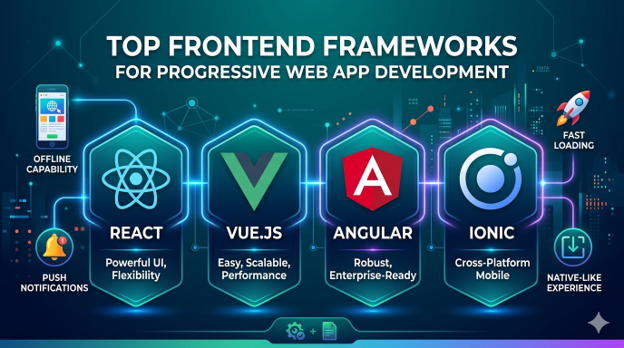
Global market revenues for progressive web apps in 2025 amounted to $2.47 billion, and the market is expected to expand at a 30.2% CAGR, reaching $34.58 billion by 2035. That figure says it all. Businesses are quickly adopting PWA, and the choice of the front-end framework used directly impacts the performance, scalability, and user retention of your app.
The PWA is a technology that provides app-like experiences from a regular browser. They can be offline, push, speedy, and set on a home screen without the need for an application shop. For example, Flipkart’s PWA resulted in a 70% conversion uplift and triple time spent on site. These outcomes are the reason why each and every progressive web app development firm now focuses on framework selection as their tech strategy.
In this guide, we’ll explore the most popular frontend frameworks for building PWA applications in 2025 and determine which is best suited for your project.
1. React.js
As of 2025, React accounts for approximately 40% of the market for frontend frameworks. It’s the most popular library for creating PWA for a reason.
Reusable UI elements can be written in a simple way using the component-based architecture of React. It has a virtual DOM for fast rendering. React can be paired with Next.js to introduce server-side rendering, static site generation, and automatic code splitting. All of these are essential for performance-enhancing PWAs.
Best for: eCommerce sites, SaaS dashboards, content-heavy applications that require quick loading and SEO benefits.
Key PWA advantages:
- Large ecosystem with dedicated PWA libraries
- Strong community support and long-term maintenance
- Next.js integration simplifies service worker setup and caching strategies
- 200,000+ GitHub stars reflect broad developer trust
React is the default starting point for most progressive web app development services today.
2. Vue.js
In the last year, Vue.js has seen a 20% adoption increase. It’s Angular on top of React with a more forgiving learning curve.
Progressive adoption model is one of the more applicable one used in Vue and it is very helpful for the teams moving from the traditional web applications to PWA. Vue can be introduced incrementally, without having to rebuild from scratch. Vue CLI includes first-class support for PWA, and enables service worker registration and manifest configuration out-of-the-box.
Best for: Startups, teams with mixed frontend experience, lightweight apps where development speed is the key.
Key PWA advantages:
- Built-in PWA plugin handles service worker generation automatically
- Smaller bundle size compared to Angular
- Vue 4’s improved TypeScript support makes large-scale PWA maintenance easier
- Excellent documentation reduces onboarding time
3. Angular
Google’s full-featured framework, Angular continues to be a solid option for enterprise PWAs. It comes with Angular Service Worker as a first class feature, which means that it is relatively easy to configure for offline support as opposed to having to do it manually in other frameworks.
With an opinionated architecture, Angular ensures uniformity of coding patterns with big teams. This is important in an enterprise setting, where multiple developers are collaborating on a PWA for several years. TypeScript is also built in by default, minimizing runtime mistakes in more intricate applications.
Best for: Enterprise apps, government apps, complex data-driven PWA apps with large teams.
Key PWA advantages:
- Native service worker module with zero third-party dependencies
- Strong dependency injection and modular architecture
- Angular Material provides accessible, PWA-ready UI components
- Built-in lazy loading improves PWA performance out of the box
4. Svelte and SvelteKit
Svelte is fundamentally different from React and Vue. Svelte doesn’t run in the browser; it compiles your code to regular JavaScript at build time. The net effect: No virtual DOM overhead, smaller bundle sizes, and faster runtime performance.
SvelteKit, the full stack counterpart of Svelte, natively supports service workers and offers a seamless adapter system for deployment to different hosting environments with PWA. If you’re looking for a PWA where performance is paramount, you should definitely consider using Svelte.
Best for: Performance-centric PWAs, mobile-first traffic, apps with a bundle size sensitive conversion rate.
Key PWA advantages:
- Compiled output is significantly lighter than virtual DOM alternatives
- SvelteKit’s service worker integration is built into the framework
- No runtime library overhead means faster Time to Interactive (TTI)
- Gaining fast developer community traction
5. Next.js (React-Based)
Next.js really deserves its own entry. It’s a built on React, and it’s the framework of choice for many teams creating production PWAs. It holds about 20% of the market share among modern JavaScript frameworks.
PWAs are hard to do, but Next.js takes care of all the complexities: server-side rendering, image optimization, automatic code splitting and incremental static regeneration. The plugin contains workbox for service worker configuration, with minimal setup.
Best for: Any PWA with both high SEO and app-like user experience, content publishing platforms, e-commerce stores.
Key PWA advantages:
- SSR + static generation options in one framework
- Image optimization reduces PWA load time significantly
- File-based routing simplifies project structure at scale
- Active Vercel-backed development ensures long-term support
How to Choose the Right Framework?
There are four key elements to the right framework that are team experience, project complexity, performance requirements, and long-term maintenance needs.
| Framework | Best Fit | PWA Setup Complexity |
| React + Next.js | Scalable, SEO-critical apps | Medium |
| Vue.js | Rapid development, small teams | Low |
| Angular | Enterprise, large teams | Low (native support) |
| Svelte/SvelteKit | Performance-first, lean bundles | Medium |
If your team is already familiar with React, Next.js will generally be the choice of your team for building a PWA. Vue is the quickest way to get a PWA app up and running and installable if you’re starting anew with a smaller team.
Final Thoughts
The selection of framework is not simply a technical decision. You will get proper assistance if you choose an expert progressive web app development company. It impacts how quickly your PWA can develop, the cost of maintenance, who you hire and, ultimately, how your PWA performs in users’ hands.
PWAs resulted in session length being 70% longer and page views per session being 20% higher compared to traditional web apps. Those benefits only come to fruition when the right structure is aligned with the needs of the project.
In 2025, the frameworks discussed are the top choices for creating fast, reliable, and engaging PWA applications, whether you’re working with a PWA development company or professional PWA development services.
Don’t just go with what’s popular, take into account your team’s strengths, performance goals, and the big picture of your product.