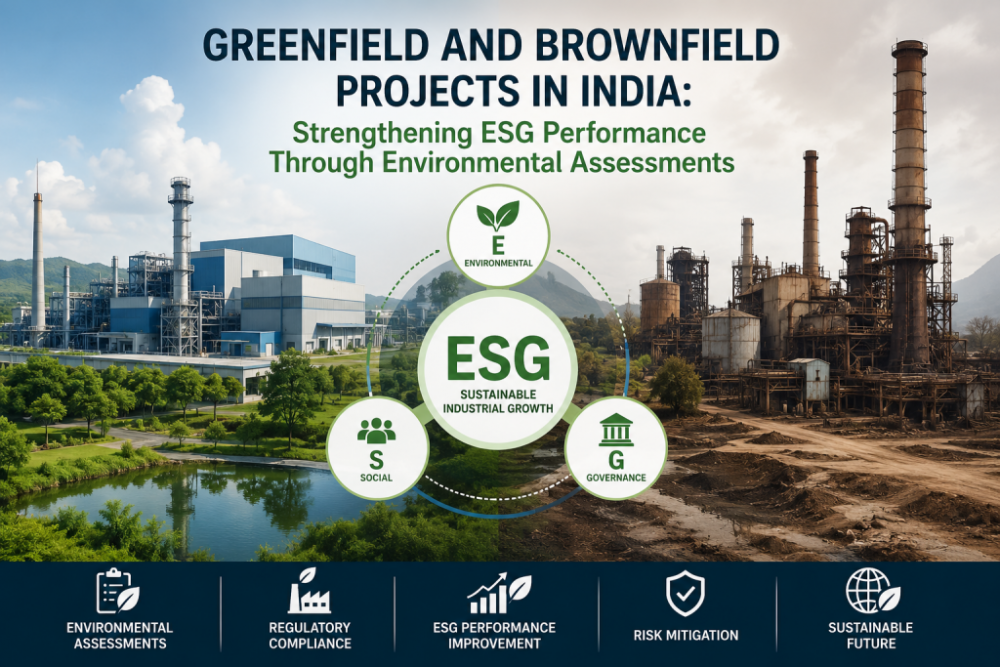
Environmental performance has evolved from a regulatory requirement into a key measure of business credibility, investor confidence, and ESG performance. Whether developing a new facility or expanding an existing one, environmental assessments now influence far more than project approvals—they shape long-term sustainability outcomes.
This shift is increasingly visible across Greenfield and Brownfield Projects in India. SEBI’s Business Responsibility and Sustainability Reporting (BRSR) framework requires the country’s top 1,000 listed companies to disclose around 140 ESG indicators, while BRSR Core currently covers 49 standardised KPIs and is being expanded through FY 2026-27. As a result, environmental data generated during project planning is becoming critical for both regulatory compliance and investor reporting.
At the same time, the Environmental Impact Assessment (EIA) Notification, 2006 continues to govern new industrial developments and many expansion projects. This growing convergence between environmental clearance requirements and ESG disclosure obligations means that environmental assessments are no longer just approval tools—they are becoming a foundation for long-term ESG performance.
Why Environmental Assessment Quality Now Determines ESG Outcomes
- SEBI’s BRSR framework mandates disclosure across approximately 140 ESG indicators for India’s top 1,000 listed companies, covering greenhouse gas emissions, energy consumption, water usage, and waste generation data points that originate from the same environmental baseline studies conducted during project assessment
- BRSR Core’s 49 standardised KPIs, introduced by SEBI, are subject to mandatory third-party assessment on a phased basis beginning with the largest 150 companies and expanding to the full 1,000 BRSR-obligated entities by FY 2026-27, per SEBI’s implementation timeline
- From FY 2024-25, India’s top 250 listed companies are required to disclose the ESG footprint of their value chain, extending environmental accountability beyond a company’s own facilities to its suppliers and contractors including those engaged for greenfield and brownfield construction
- Every project requiring environmental clearance under the EIA Notification, 2006, must generate a baseline Environmental Impact Assessment (EIA) report and Environmental Management Plan (EMP) before construction the same data architecture that underpins credible BRSR-level environmental disclosure later
Greenfield Projects: Environmental Assessment From a Clean Baseline
Greenfield projects facilities built on land with no prior industrial use carry the advantage of a clean environmental baseline, but that advantage only translates into strong ESG outcomes if the assessment itself is rigorous.
- Site selection and EIA scoping determine the long-term environmental footprint of the facility proximity to water bodies, forest land, and ecologically sensitive zones identified during the assessment stage shapes mitigation costs for the entire operating life of the plant
- Baseline environmental data ambient air quality, groundwater levels, soil characteristics, and biodiversity surveys collected during the EIA process becomes the reference point against which the facility’s future emissions and resource consumption are measured and disclosed
- Public consultation, a mandatory component of the environmental clearance process for Category A projects under the EIA Notification, 2006, surfaces community and stakeholder concerns early reducing the social risk exposure that ESG frameworks increasingly weigh alongside environmental metrics
- A greenfield project designed with renewable energy integration, water recycling, and zero-liquid-discharge systems built into the original facility layout typically achieves materially stronger long-term ESG metrics than retrofitting these systems onto an operational facility later
Brownfield Projects: Managing ESG Risk Within an Operating Footprint
Brownfield projects expansions or upgrades within an existing industrial facility carry a different environmental assessment burden: the facility’s existing environmental compliance history and operational footprint must be factored into any expansion-stage assessment.
- Brownfield expansions that increase production capacity, change raw material inputs, or modify effluent characteristics typically require an amendment to the existing environmental clearance or, depending on scale, a fresh assessment under the EIA Notification, 2006 not an automatic extension of the original approval
- Legacy environmental liabilities historical soil or groundwater contamination, undocumented effluent discharge, or non-compliant waste storage are frequently uncovered only when a brownfield expansion triggers a fresh environmental assessment, making this a critical due diligence point for both operators and investors
- Utility and effluent treatment infrastructure sized for the original facility must be reassessed against the expanded production volume, since under-sized environmental infrastructure is a common source of compliance breaches that surface in subsequent ESG audits
- Brownfield assessments that integrate energy efficiency retrofits, emissions reduction technology, and water recycling alongside the core expansion deliver a measurably stronger ESG improvement trajectory than expansions that treat environmental upgrades as a separate, later-stage initiative
Connecting Project-Stage Environmental Assessment to BRSR Disclosure
The link between environmental clearance documentation and ESG disclosure is frequently underappreciated by Indian manufacturers, despite both processes drawing on the same underlying environmental data.
- Baseline air, water, and soil quality data collected for environmental clearance feeds directly into the environmental indicators companies must report under BRSR’s essential and leadership indicator sections
- Environmental Management Plans developed during the clearance process covering pollution control, waste management, and biodiversity conservation measures form the operational basis for the environmental commitments companies disclose and are held accountable to in subsequent BRSR cycles
- As third-party assurance requirements under BRSR Core extend to a wider set of companies through FY 2026-27, the audit trail and documentation quality established at the original environmental assessment stage becomes the foundation auditors rely on to verify reported figures
- Manufacturers with PLI-linked production milestones face a layered compliance burden: PLI scheme performance, environmental clearance conditions, and BRSR-level ESG disclosure are governed by separate authorities but increasingly draw on the same underlying environmental performance data
Common Gaps That Undermine ESG Performance at the Project Stage
- Treating the EIA report as a one-time regulatory submission rather than a living document that should inform ongoing environmental monitoring and future BRSR disclosure
- Under-scoping public consultation and social impact assessment, which can resurface later as governance or social-pillar weaknesses in ESG evaluations even when the environmental clearance itself was technically compliant
- Sizing effluent treatment and pollution control infrastructure to bare regulatory minimums rather than to the facility’s planned expansion trajectory, creating a compliance gap the moment brownfield growth occurs
- Failing to retain environmental monitoring data in an auditable format, which becomes a direct obstacle when third-party BRSR Core assurance requirements apply to the company
- Overlooking value-chain environmental exposure since India’s largest listed companies must now disclose ESG performance across significant suppliers and contractors, a manufacturer’s own environmental assessment quality can directly affect a customer’s ESG disclosure
How IMARC Engineering Supports ESG-Aligned Environmental Assessments
IMARC Engineering provides environmental assessment, regulatory clearance, and ESG-readiness advisory services for manufacturers executing greenfield and brownfield industrial projects across India.
- Environmental Impact Assessment (EIA) and Environmental Management Plan (EMP) preparation aligned with EIA Notification, 2006 requirements and MoEFCC procedural standards
- Brownfield environmental due diligence, identifying legacy compliance gaps and infrastructure sizing risks before expansion-stage clearance applications are filed
- Baseline environmental data architecture designed to feed directly into BRSR and BRSR Core disclosure requirements, reducing duplication between regulatory and ESG reporting workstreams
- Effluent treatment, water recycling, and pollution control infrastructure sizing aligned to both current operations and planned expansion trajectories
- Support for value-chain ESG readiness, helping manufacturers respond to environmental data requests from listed customers subject to SEBI’s value-chain disclosure requirements
As industrial capacity utilisation rises, partnering with specialist brownfield project management consultants in India.
Environmental Assessment Quality Is Now an ESG Performance Decision
The regulatory direction is unambiguous:
- SEBI’s BRSR framework already covers India’s top 1,000 listed companies across roughly 140 ESG indicators, with third-party assurance requirements expanding through FY 2026-27
- Value-chain ESG disclosure requirements, effective from FY 2024-25 for India’s top 250 companies, extend environmental accountability into supplier and contractor relationships
- Every greenfield project and most brownfield expansions remain governed by the EIA Notification, 2006, generating the same baseline environmental data that downstream ESG disclosure depends on
Manufacturers who treat environmental assessment as a one-time regulatory hurdle, separate from ESG strategy, will increasingly find that gap surfacing as a disclosure weakness, an assurance failure, or a lost customer relationship as value-chain ESG scrutiny expands. Those who build environmental assessment and ESG data architecture together at the greenfield design stage or the brownfield expansion stage convert a compliance obligation into a durable competitive position.
Conclusion
The relationship between environmental assessments and ESG performance is becoming increasingly direct across Indian industry. As BRSR disclosures expand, third-party assurance requirements increase, and value-chain ESG scrutiny extends beyond individual facilities, the quality of environmental assessment conducted during project planning will have a lasting impact on compliance, investor confidence, and operational sustainability.
For both greenfield and brownfield projects, environmental assessments provide more than a pathway to regulatory approval. They help identify environmental risks, strengthen resource planning, support future ESG reporting obligations, and improve long-term project resilience. Manufacturers that integrate environmental and ESG considerations at the earliest stages of project development will be better positioned to meet evolving stakeholder expectations and create sustainable competitive advantage in an increasingly ESG-focused business environment.
As ESG expectations continue to evolve, partnering with specialist environmental assessment consultants in India can help organisations strengthen compliance, reduce risk, and support sustainable industrial growth.