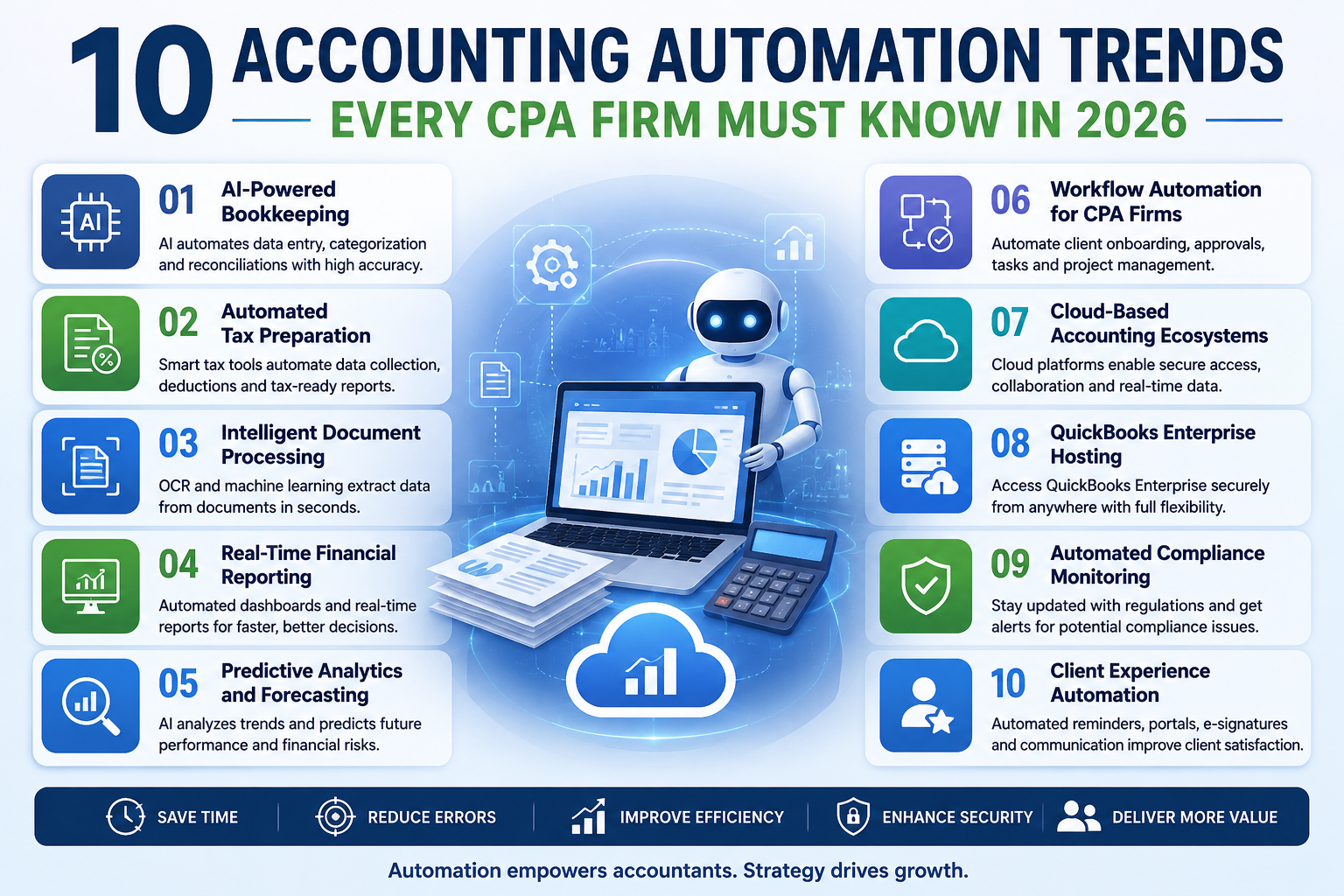
The accounting profession is evolving faster than ever. As client expectations grow and financial regulations become increasingly complex, CPA firms are turning to automation to improve efficiency, accuracy, and profitability. In 2026, accounting automation is no longer a competitive advantage—it’s a necessity.
From artificial intelligence (AI) to cloud-based collaboration, automation technologies are reshaping how accounting firms operate. Firms that embrace these innovations can reduce manual workloads, enhance client service, and focus more on strategic advisory services.
Here are the top 10 accounting automation trends every CPA firm should know in 2026.
1. AI-Powered Bookkeeping
Artificial intelligence continues to transform bookkeeping processes. Modern accounting systems can automatically categorize transactions, reconcile accounts, and identify inconsistencies with minimal human intervention.
This reduces time spent on routine tasks while improving accuracy and allowing accountants to focus on higher-value work.
2. Automated Tax Preparation
Tax preparation software is becoming smarter every year. Advanced automation tools can collect financial data, identify deductions, validate information, and generate tax-ready reports automatically.
CPA firms are leveraging these solutions to streamline tax season, minimize errors, and improve turnaround times for clients.
3. Intelligent Document Processing
Manual data entry is rapidly becoming a thing of the past. Intelligent document processing technologies use machine learning and optical character recognition (OCR) to extract information from invoices, receipts, bank statements, and financial documents.
This automation significantly reduces administrative work and enhances data accuracy.
4. Real-Time Financial Reporting
Clients increasingly expect instant access to financial information. Automated reporting systems now provide real-time dashboards and performance metrics that help businesses make informed decisions quickly.
CPA firms can deliver greater value by offering continuous financial insights rather than relying solely on periodic reports.
5. Predictive Analytics and Forecasting
Automation tools are moving beyond historical reporting and into predictive analysis. Modern platforms can analyze trends, forecast cash flow, predict expenses, and identify potential financial risks before they become major issues.
This enables accountants to take a proactive advisory role and help clients make smarter business decisions.
6. Workflow Automation for CPA Firms
Internal workflow automation is becoming essential for accounting firms looking to improve productivity.
Tasks such as client onboarding, document requests, approval processes, appointment scheduling, and project tracking can now be automated. This reduces bottlenecks, improves team collaboration, and ensures deadlines are consistently met.
7. Cloud-Based Accounting Ecosystems
Cloud accounting continues to gain momentum as firms embrace remote and hybrid work environments. Cloud platforms provide secure access to financial data from anywhere, making collaboration easier between accountants and clients.
The ability to access real-time information has become a critical requirement for modern accounting operations.
8. QuickBooks Enterprise Hosting for Greater Flexibility
As CPA firms adopt more automation tools, having reliable cloud infrastructure becomes increasingly important.
QuickBooks Cloud Hosting is helping firms modernize their accounting operations by providing secure, remote access to QuickBooks Enterprise from any location. Instead of being tied to a single office computer, teams can work collaboratively in a cloud-hosted environment while accessing real-time financial data.
For growing CPA firms, QuickBooks Enterprise Hosting offers several advantages:
- Secure remote access
- Multi-user collaboration
- Automatic data backups
- Improved business continuity
- Enhanced scalability
- Better support for automation integrations
By combining automation technologies with cloud-hosted accounting software, firms can improve operational efficiency while maintaining data security and compliance.
9. Automated Compliance Monitoring
Keeping up with changing tax laws and financial regulations can be challenging. Automated compliance solutions now monitor regulatory updates and flag potential issues before they become costly problems.
This helps CPA firms reduce compliance risks while ensuring clients remain aligned with evolving requirements.
10. Client Experience Automation
Today’s clients expect fast communication and seamless service. Automation tools are helping firms improve the client experience through automated reminders, secure document sharing, digital signatures, appointment scheduling, and client portals.
These solutions enhance engagement while reducing administrative workload for accounting teams.
Preparing for the Future of Accounting
The future of accounting is not about replacing accountants—it is about empowering them. Automation technologies are handling repetitive and time-consuming tasks, allowing professionals to focus on strategic consulting, business advisory services, and client relationships.
CPA firms that invest in automation today will be better positioned to meet growing client expectations, improve operational efficiency, and remain competitive in an increasingly digital marketplace.
Whether it’s AI-powered bookkeeping, predictive analytics, workflow automation, or QuickBooks Enterprise Hosting, the firms that embrace innovation will lead the next generation of accounting services.
Conclusion
Accounting automation is reshaping the CPA industry in 2026. Firms that leverage these technologies can reduce manual workloads, improve accuracy, and provide more valuable insights to clients.
By combining intelligent automation with solutions like QuickBooks Enterprise Hosting, CPA firms can create a more flexible, efficient, and future-ready accounting environment. The goal is not simply to automate processes but to unlock new opportunities for growth, profitability, and client success.